

Ebola
An outbreak of Ebola disease caused by the Bundibugyo virus is currently underway in eastern Democratic Republic of Congo, with cases also reported in Uganda. The World Health Organization declared this outbreak a public health emergency of international concern in May 2026, and the Africa Centres for Disease Control and Prevention (Africa CDC) subsequently declared it a Public Health Emergency of Continental Security on 18 May 2026. Bundibugyo is a rare cause of Ebola, related to the more familiar Zaire Ebola strain responsible for most previous outbreaks. There is currently no readily available rapid diagnostic test, no treatment, and no vaccine for this strain, meaning that public health containment measures remain the only line of defence.
While the outbreak is concentrated in the DRC and Uganda, imported cases of Ebola in South Africa are a possibility and there is a need to prepare now. CAPRISA is actively engaged in the response to this outbreak: CAPRISA Director Prof Salim S. Abdool Karim chairs the Africa CDC Emergency Consultative Group, whose recommendations underpinned the continental emergency declaration, and serves as Special Advisor to the Director-General of the World Health Organization. CAPRISA will also be collating data to inform the regional response. The resources here provide further information on the virus, the current situation, and the response.
-
📌 🗓️ [SAVE THE DATE] Wednesday, 26 August 2026
Ebola is once again testing health systems in eastern DRC, in communities already living with conflict and fragile services. The people leading that response are doing so in a global health landscape that has changed profoundly: financing is being reconfigured, donor commitments have contracted, and the surveillance, treatment and workforce arrangements that Africa has relied on for two decades can no longer be assumed. This webinar looks at what it takes to respond to Ebola, and to prepare for the next pandemic, under those conditions. It examines the rights implications of the current outbreak, the operational realities facing clinicians and health authorities, and the legal and political tools available to hold responses to account. The intention is not simply to document how difficult the situation is, but to ask what comes next: how African institutions, courts, health authorities and researchers build durable pandemic capacity of their own, what governments and international health actors must do to protect patients, health workers and affected communities, and how lessons from the DRC can inform more equitable and accountable outbreak responses across the continent. -
Ebola epidemic in the DRC: My observations & reflections by Professor Salim Abdool Karim. This follows Professor Abdool Karim's trip to the Democratic Republic of Congo (DRC) on behalf of the Africa CDC, in June 2026. Access the full report in PDF here. Access the full report in PowerPoint here.
-
The World Health Organisation declared Ebola outbreak caused by the Bundibugyo strain a Public Health Emergency of International Concern. It's recommendations on how countries should respond is available here: https://www.who.int/news/item/17-05-2026-epidemic-of-ebola-disease-in-the-democratic-republic-of-the-congo-and-uganda-determined-a-public-health-emergency-of-international-concern
-
The Africa CDC declared this outbreak caused by the Bundibugyo strain a public health emergency of continental concern. It releases situation reports on cases which are available here: https://africacdc.org/download/situation-report-bundibugyo-virus-disease-outbreak-in-the-drc-and-uganda/
-
The NICD has issued important guidance on reporting and testing for the Bundibugyo strain of the Ebolavirus. https://www.nicd.ac.za/diseases-a-z-index/bundibugyo-virus-disease/
-
The US CDC is aggregating data from Ministries of Health in the DRC and Uganda to provide updated figures on the outbreak. The latest figures released are available here: https://www.cdc.gov/ebola/situation-summary/index.html
Media Interviews
- [WEBINAR] Building Africa's Pandemic Response: Whose job is it?
- [WEBINAR] Urgent Global Virus Network Media Briefing: Ebola in the Democratic Republic of the Congo
- TRT World - Race to contain rare Ebola strain in war-torn DRC
- Sky News - Ebola Outbreak. Who declares international emergency?
- Newzroom Afrika - South Africa urged to be alert for possible virus outbreak
- SABC News 404 - WHO declares Ebola outbreak a global health emergency
Print Articles
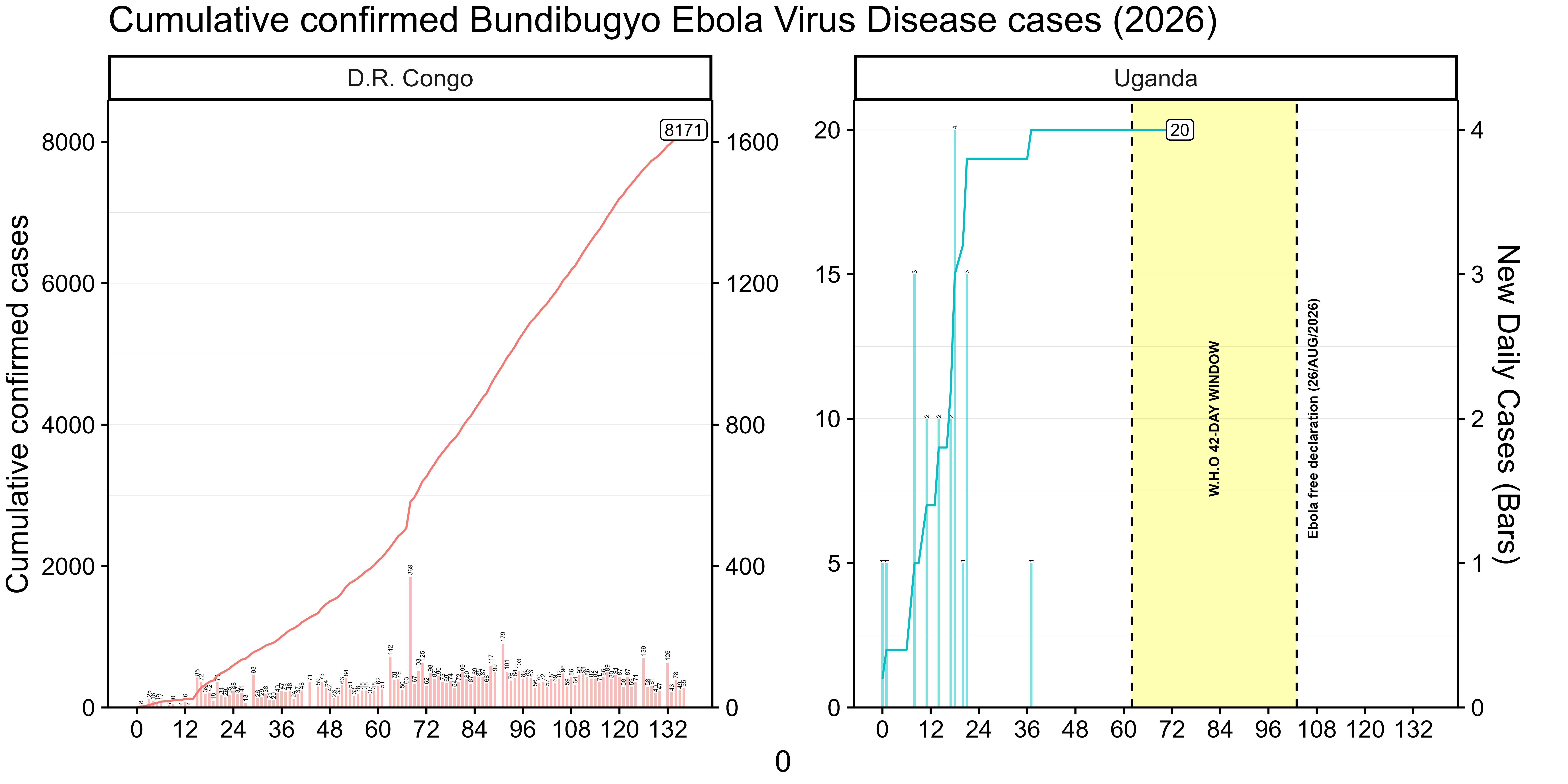
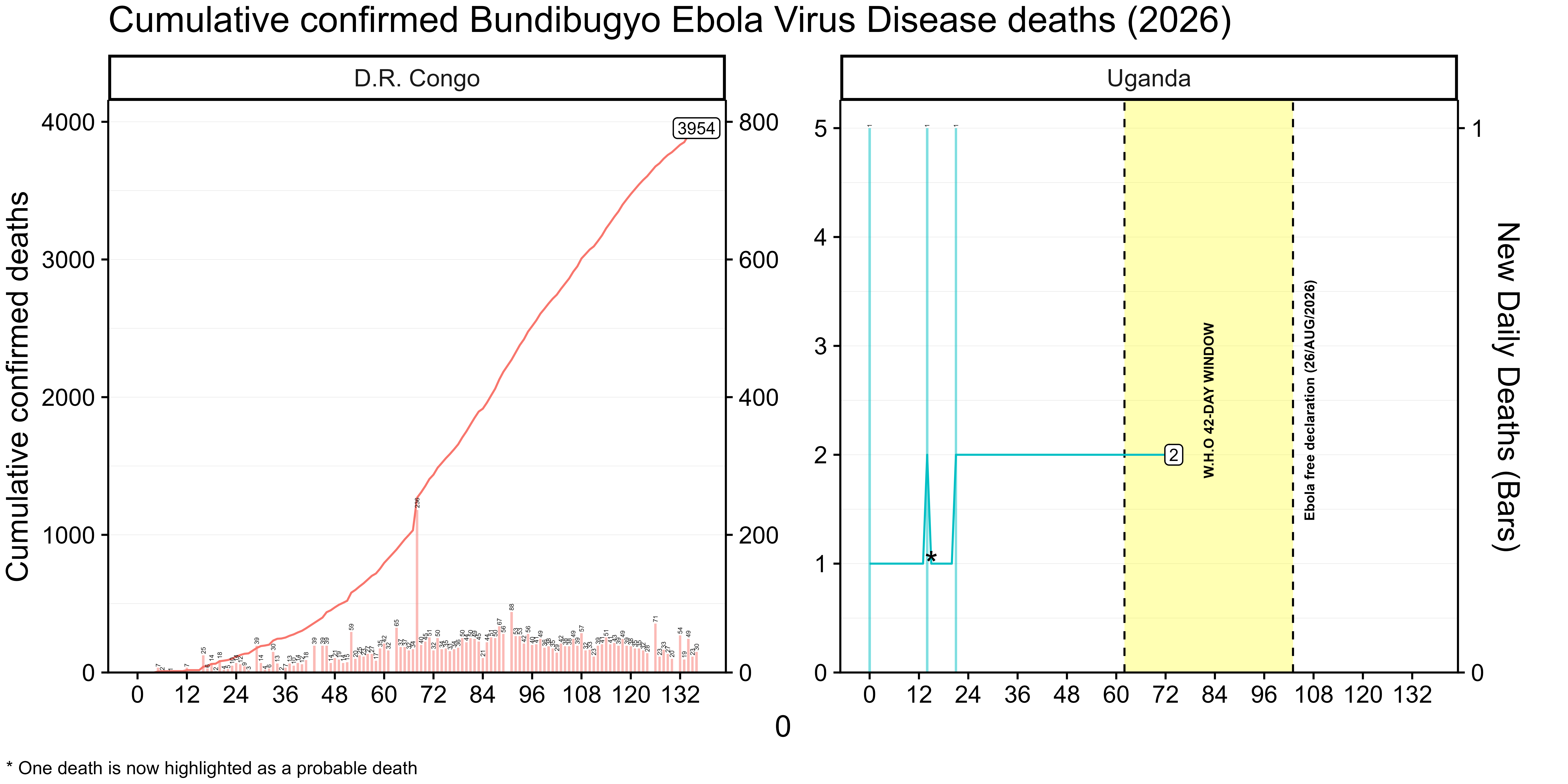
These graphs track the confirmed cases and confirmed deaths of Bundibugyo ebolavirus in the Democratic Republic of Congo and Uganda based on data reported by the World Health Organization, the Africa CDC, the US Centers for Disease Control and Prevention, the European CDC, UNICEF and the Ministry of Health in Uganda. Given the limited availability of data, we are aggregating data from multiple sources. *To note, the World Health Organisation declared the 2026 Ebola outbreak in Uganda over on August 26, 2026, after the country successfully completed 42 consecutive days without a new confirmed case.
Analysis: CAPRISA
For inquiries, contact outbreaks@caprisa.org